
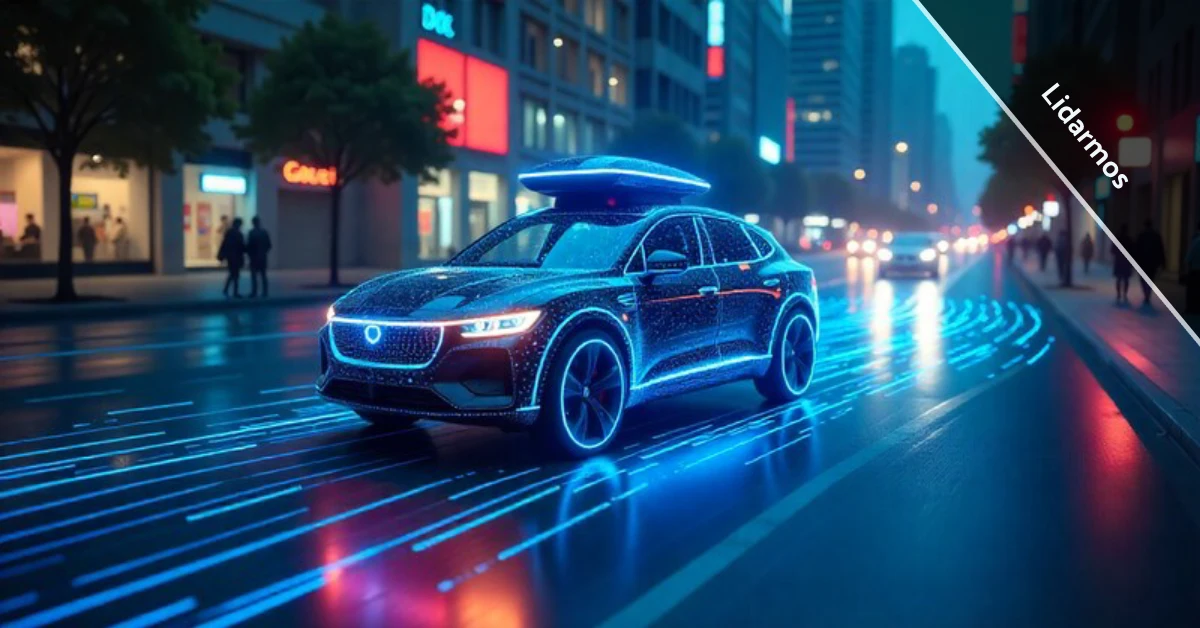
Lidarmos represents the convergence of LiDAR (Light Detection and Ranging) technology with artificial intelligence, robotics, and autonomous systems. This integration creates machine perception capabilities that enable vehicles, robots, and smart devices to understand and navigate their environments with centimeter-level precision.
What Lidarmos Represents in Modern Technology
Lidarmos functions as both a concept and a platform where LiDAR sensing technology meets intelligent automation. Rather than being a single product, it represents an ecosystem of technologies working together to solve real-world challenges in navigation, mapping, and object detection.
The core principle involves using laser pulses to measure distances and create detailed three-dimensional maps called point clouds. These point clouds contain millions of data points that represent physical spaces with remarkable accuracy. When combined with AI processing, this raw spatial data transforms into actionable intelligence that machines can use to make decisions.
Companies like Waymo and Motional have demonstrated this technology in practice. Waymo’s autonomous vehicles complete over 250,000 paid rides weekly as of 2025, relying heavily on LiDAR systems to detect pedestrians, vehicles, and obstacles in real time. This isn’t experimental technology anymore. It’s operational infrastructure supporting actual transportation services.
How LiDAR Technology Powers Machine Perception
LiDAR works by emitting rapid laser pulses and measuring the time it takes for reflected light to return to the sensor. This time-of-flight measurement allows the system to calculate precise distances to objects in every direction.
A single LiDAR sensor can emit hundreds of thousands of laser pulses per second. Each pulse that bounces back provides a data point in three-dimensional space. Over time, these points accumulate into detailed maps showing the exact shape and position of everything around the sensor.
The technology operates effectively in various lighting conditions, unlike cameras that struggle in darkness or bright sunlight. This reliability makes LiDAR particularly valuable for safety-critical applications where consistent performance matters more than cost.
Mechanical vs Solid-State LiDAR Systems
Two main approaches dominate the LiDAR landscape. Mechanical systems use spinning components to scan the environment in 360 degrees. These sensors provide comprehensive coverage but tend to be bulky and expensive. Companies like Velodyne pioneered this approach, and it remains common in autonomous vehicle testing.
Solid-state LiDAR eliminates moving parts entirely. Without mechanical components, these sensors become smaller, cheaper, and more durable. The tradeoff involves a narrower field of view, though this matters less for applications with predictable scanning needs. Solid-state systems have dropped significantly in cost over recent years, making them viable for consumer applications.
MEMS (Microelectromechanical Systems) LiDAR represents a middle ground. It uses tiny mirrors that tilt to direct laser beams, combining compact size with reasonable coverage. This approach has gained traction in automotive applications where space and cost constraints are critical.
The Role of AI in Lidarmos Systems
Raw LiDAR data consists of millions of points in space. Without intelligent processing, this information remains just coordinates with no meaning. AI transforms point clouds into understanding.
Machine learning algorithms trained on vast datasets can identify objects within point cloud data. The system learns to recognize the characteristic shape of a pedestrian versus a bicycle versus a parked car. This classification happens in real time, allowing autonomous systems to react to their environment within milliseconds.
Deep learning models also filter noise from LiDAR data. Reflections from rain, fog, or dust can create false readings. AI helps distinguish genuine objects from environmental interference, improving reliability in challenging conditions.
Pattern recognition extends to predicting movement. By analyzing sequential scans, AI can estimate the velocity and trajectory of moving objects. An autonomous vehicle doesn’t just see a pedestrian at the curb—it predicts whether that person will step into the road.
Key Applications Across Industries
LiDAR technology integrated with AI serves diverse sectors beyond transportation. Each application leverages the same core capabilities while addressing industry-specific challenges.
Environmental scientists use airborne LiDAR to map forest canopy structure and measure biomass. The technology can penetrate vegetation to create ground elevation models even in densely forested areas. This data supports conservation efforts, wildfire management, and climate research.
Construction firms deploy mobile LiDAR to document job sites. Progress tracking becomes automated when current scans are compared against design models. Any deviation from plans gets flagged immediately, preventing costly errors from compounding over time.
Agriculture benefits from crop monitoring using LiDAR-equipped drones. The technology measures plant height and density across entire fields, identifying areas that need attention. This precision enables targeted application of water and fertilizer, reducing waste while improving yields.
Smart city initiatives incorporate LiDAR for traffic management. Sensors mounted at intersections track pedestrian and vehicle flow, providing data that optimizes signal timing. Some systems detect falls or accidents, automatically alerting emergency services.
Autonomous Vehicles and Lidarmos Technology
Self-driving cars represent the most visible application of LiDAR AI integration. These vehicles must perceive their environment with reliability that exceeds human drivers, and LiDAR provides the foundation for that perception.
Tesla initially avoided LiDAR, relying on cameras and radar, but most competitors considered it essential. Waymo’s vehicles use multiple LiDAR sensors providing overlapping coverage. This redundancy ensures that if one sensor fails or gets obscured, others maintain awareness.
The system must distinguish between hundreds of object types. A paper bag blowing across the road requires a different response than a child running into traffic. Both appear as objects in the point cloud, but AI determines which poses an actual threat.
Range matters significantly in highway driving. Long-range LiDAR can detect objects 300 meters ahead, giving autonomous systems time to plan lane changes or braking. Near-field sensors handle immediate surroundings during parking or slow-speed maneuvers.
Honda achieved Level 3 autonomy certification in 2021 for its Legend sedan in Japan, allowing drivers to legally take their hands off the wheel in certain conditions. Mercedes-Benz followed with its S-Class. Both systems rely heavily on LiDAR for the perception confidence required by regulators.
Robotics and Industrial Automation
Warehouse robots demonstrate practical LiDAR integration in controlled environments. Automated Guided Vehicles (AGVs) and Autonomous Mobile Robots (AMRs) navigate complex facilities while avoiding workers and obstacles.
Amazon operates over 750,000 mobile robots across its fulfillment network. These machines use various sensing technologies, with LiDAR providing primary navigation and collision avoidance. The robots must operate safely around human workers while maintaining efficiency that justifies their deployment cost.
Collaborative robots, or cobots, work directly alongside people on assembly lines. LiDAR enables these machines to detect when a human enters their workspace and slow or stop accordingly. This safety feature allows closer human-robot collaboration than traditional industrial robots permit.
Agricultural robots use LiDAR for autonomous navigation through fields. These machines handle tasks like weeding, planting, or harvesting while avoiding damage to crops. The technology must work reliably in variable outdoor conditions with uneven terrain and changing lighting.
Manufacturing facilities employ LiDAR for quality control. Automated inspection systems scan completed products, comparing actual dimensions against design specifications. This approach catches defects that human inspectors might miss while operating at higher speeds.
Current Challenges and Future Developments
Cost remains a barrier despite significant price reductions. Solid-state LiDAR sensors that cost over $75,000 a decade ago now retail for under $1,000, but that still represents a substantial expense for consumer applications. Further miniaturization and production scaling should drive costs lower.
Weather conditions affect performance. Heavy rain or snow can scatter laser pulses, reducing range and accuracy. Fog presents particular challenges because water droplets suspended in the air create false returns. AI helps filter these artifacts, but physical limitations remain.
Data processing demands grow as sensors become more powerful. A modern LiDAR unit generates gigabytes of data per second. Converting this information into decisions requires significant computing power, which consumes energy and generates heat. Edge computing architectures help by processing data locally rather than sending everything to central computers.
Integration with other sensors improves overall system performance. Camera data provides color and texture information that LiDAR lacks. Radar works through fog and rain, but with lower resolution. Combining multiple sensor types through sensor fusion creates a more robust perception than any single technology achieves alone.
The technology continues evolving rapidly. Research focuses on increasing range, improving resolution, and reducing power consumption. Some companies explore different wavelengths that penetrate the weather better or remain safer for human eyes. Others work on AI models that require less training data while achieving higher accuracy.
Regulatory frameworks are developing alongside the technology. Governments must balance safety requirements with innovation. Clear standards help manufacturers design systems that regulators will accept while ensuring public safety in applications like autonomous vehicles.
Lidarmos technology has moved from research labs to real-world deployment across multiple industries. The combination of precise sensing and intelligent processing creates capabilities that were impossible just years ago. As costs decrease and performance improves, applications will expand further into everyday life.
