
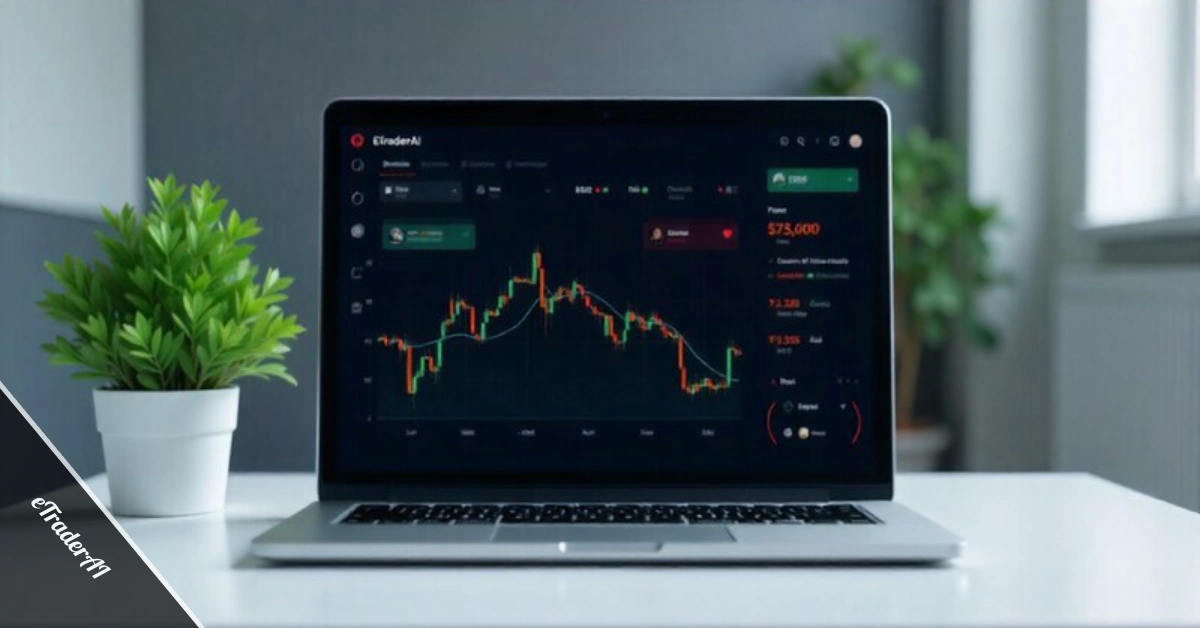
eTraderAI is an automated trading bot using AI to analyze markets and execute trades on your behalf across crypto, forex, and stocks. It requires a $250 minimum deposit, no regulatory licensing, and carries inherent market risks. Demo testing before live trading is essential.
What eTraderAI Actually Is
eTraderAI is a web-based trading platform that uses algorithms and artificial intelligence to automate trading decisions. You connect your account to a broker, set your parameters, and the system scans live market data to find trading opportunities. When it identifies a signal, it can automatically buy or sell without your intervention.
The platform is browser-based with no software download required. It works across crypto (Bitcoin, Ethereum, other altcoins), forex pairs, and stocks. This is not the same as ETRADE, the established brokerage owned by Morgan Stanley. The similarity in names confuses, but they are completely different products. ETRADE is a regulated broker where you place trades yourself. eTraderAI is an unregulated AI bot that trades on your behalf.
The core appeal is simple: you don’t need to watch charts all day or have years of trading experience. The system handles the monitoring and execution. For busy people or those intimidated by markets, this sounds attractive. But the phrase “automated trading” comes with real risks that deserve honest attention.
How the Platform Works (The Real Mechanics)
eTraderAI analyzes market data in real-time using machine learning. It looks at price movements, trading volume, historical patterns, and sometimes sentiment indicators. Based on these inputs, it generates trading signals.
Here’s the critical part: the bot doesn’t hold your money. You deposit funds into a connected broker account. The broker executes the trades. eTraderAI is a signal-generating and execution layer on top of that broker account. If the broker has issues or is unregulated, your funds are at risk regardless of how good the algorithm is.
The platform offers two modes. Demo mode gives you virtual funds so you can watch the algorithm perform without real money. Live mode uses your actual deposit. Many users test in demo first to see if the system’s historical performance translates to real trading. (Spoiler: it often doesn’t.)
The trading process works like this. You define parameters: which assets to trade, how much risk per trade, when to exit (stop-loss), and when to take profit (take-profit). The system monitors markets 24/7 and places orders when conditions match your rules. All execution happens through the connected broker’s API.
This automation eliminates emotional decisions in theory. Fear and greed don’t cloud the algorithm’s judgment. But algorithms have different problems: they can react poorly to unprecedented market events, they can overfit to historical data, and they can execute at the wrong time due to slippage or delays.
Key Features Explained
Real-Time Trading Signals The platform scans markets continuously and alerts you (or automatically executes) when it identifies a potential trade. This happens 24/7, even while you sleep. The speed is an advantage in fast-moving markets, but speed also means you might miss nuance that a human trader would catch.
Risk Management Settings: You can set stop-loss and take-profit levels for each trade. A stop-loss automatically sells if a position drops beyond your tolerance. Take-profit closes the position once you hit your target gain. These tools are essential because they cap losses and lock in wins. Without them, you’re exposed to unlimited downside.
Backtesting Capability: eTraderAI lets you test your strategy against historical data before going live. You can see how a set of parameters would have performed over the past 1, 5, or 10 years. This is useful for reality-checking your ideas, but it’s also dangerous. Past performance never guarantees future results. Markets change. What worked in 2020 might fail in 2025.
Demo Account: Start with virtual funds. This lets you learn the platform, watch the bot trade, and assess whether you trust it before committing real money. It’s the safest first step. Many users skip it and regret it.
Customizable Parameters: You control which assets to trade, position size, risk tolerance, and entry/exit rules. This flexibility suits different trading styles. But customization is also a trap. Too many choices, combined with overconfidence, lead to over-optimization. You tweak settings until backtest results look perfect, then live trading fails because the real market behaves differently.
Complete Cost Breakdown
Minimum Deposit: $250. This is your trading capital, not a fee. It’s the smallest amount the platform accepts to start live trading. Some users start here; others deposit more.
Platform Fees eTraderAI itself doesn’t charge a subscription or software fee (as of late 2025). You get access to the platform for free. This is attractive, but free platforms sometimes offset costs through other means (data selling, slippage capture, etc.).
Broker Fees You’ll pay your connected broker’s fees. These vary widely. Some brokers charge per trade, others charge monthly account fees, and some are commission-free but have wider spreads. You must research your broker’s fee structure independently.
Withdrawal Fees: If your broker charges withdrawal fees, you’ll pay those. If eTraderAI charges to process withdrawals, that’s on you, too. Always ask before depositing.
Hidden Costs to Watch Slippage (the difference between the intended price and the actual execution price) eats into profits. Spread costs (the bid-ask gap) add up over many trades. If you make 100 trades a month and lose 0.1% per trade to slippage, that’s 10% annually gone. It compounds.
How to Get Started: Step-by-Step
Visit eTraderAI’s website and fill out the registration form. You’ll provide your full name, email, phone number, and country of residence. The platform runs a Know Your Customer (KYC) check to verify identity and prevent fraud. This typically takes 24–48 hours.
Once verified, you can log in and access the demo account immediately. There’s no deposit required at this stage. Spend days or weeks in demo mode. Watch the algorithm trade, tweak settings, and observe results. This costs nothing and teaches you the interface before risking money.
Funding Your Account
When you’re ready, you’ll deposit your minimum $250 (or more). eTraderAI accepts various payment methods: credit card, debit card, wire transfer, and sometimes crypto. Check which methods your country allows. Processing takes 1–5 business days, depending on your bank and payment method.
After the broker connects your account, the funds sit there until you authorize trades. You can still use demo mode after funding. Some users fund, run demo and live trades side-by-side for a week, then commit fully to live. This hybrid approach reduces shock.
Running a Demo Trade
Your demo account comes with virtual funds (often $10,000 or more). Enable the bot and set your parameters. Watch it execute trades in real-time. Track performance over weeks or months. Notice how often it wins, how big losses get, and how realistic the results feel.
Critical question: Does the demo performance feel sustainable in live trading? If the demo shows 20% monthly gains with zero losses, that’s a red flag. No strategy does that in real markets. If the demo shows steady 2–3% monthly returns with occasional 10% drops, that’s more realistic.
Move to live trading when you’re convinced the system can work in your favor and you’ve accepted the risk. Never rush this step. Demo should take at least 2–4 weeks.
Legitimacy & Safety: What You Must Know
Regulatory Status eTraderAI is not licensed by the SEC (US), FCA (UK), or ESMA (Europe). It has no top-tier regulatory backing. This is important. If something goes wrong, you can’t file a complaint with a financial regulator. You’re on your own.
Regulators worldwide have repeatedly warned that AI trading bots are increasingly used in scams. Sophisticated websites, compelling testimonials, and AI hype make scams harder to spot. The FCA and SEC specifically caution traders to verify licensing before depositing.
Broker Partnerships: The safety of your funds depends on the broker eTraderAI connects to. Before funding, verify the broker’s licensing. Is it regulated by CySEC (Cyprus), ASIC (Australia), or similar? A CySEC-licensed broker offers some protection; an unregulated offshore broker offers none.
eTraderAI’s website should list which brokers it partners with. Research each one independently. Don’t assume eTraderAI vetted them thoroughly.
Encryption & Data Security The platform uses SSL encryption to protect your login credentials and personal data. This is standard for any website handling sensitive information. But encryption doesn’t prevent fraud or guarantee the company’s honesty. It just means your data is encrypted in transit.
How to Verify Before Depositing
- Check the broker licensing yourself. Go to the broker’s regulator’s website and search for the company name.
- Search for independent reviews on Reddit, Trustpilot, and trading forums. Look for patterns: Do users report getting paid out? Or do complaints mention blocked withdrawals?
- Run the demo for 4+ weeks. If results seem too good to be true, they probably are.
- Never deposit more than you can afford to lose entirely. Treat this as speculative money, not retirement funds.
- If anyone guarantees profits, walk away. No legitimate system guarantees returns in trading.
Real Risks & Limitations
Market Volatility Breaks Algorithms: Algorithms assume markets behave predictably. They don’t. Black swan events (major unexpected market moves) can wipe out trades instantly. In March 2020, crypto and forex markets gapped massively overnight. Many automated systems couldn’t execute stop-losses because the market jumped past them.
No Profit Guarantees (Ever): This is non-negotiable. If anyone promises guaranteed returns, they’re lying. Markets are uncertain by nature. eTraderAI increases your chances of success through consistent rule-based trading, but it can’t eliminate risk.
Slippage & Execution Delays: Your algorithm spots a signal and places an order. By the time the order reaches the market and is executed, the price has moved. This gap is slippage. Over hundreds of trades, slippage compounds and eats profits. The faster your algorithm, the less slippage. But even fast systems face delays.
Overreliance on Automation: Some users set up the bot and ignore it for months. They assume it’s working perfectly. Meanwhile, market conditions shift, the algorithm’s assumptions become outdated, and losses mount. Automation isn’t “set and forget.” You need to review performance monthly and adjust as needed.
Is eTraderAI Worth Your Money?
Who It Might Suit: Hands-off traders who don’t want to analyze charts daily. Beginners who want a structured entry into automated trading. People are testing whether passive trading beats their own decisions. Disciplined users willing to set boundaries and stick to them.
Who Should Avoid It: Conservative investors who need guaranteed safety. Anyone who can’t afford to lose the minimum deposit. Traders seeking regulatory protection (you won’t get it here). People who expect guaranteed profits. Anyone who doesn’t understand the risks.
Key Decision Factors: Can you afford to lose $250 (or more)? Would losing that amount stress you financially? Are you willing to spend 4+ weeks in demo mode before going live? Can you review performance monthly and adjust? Do you understand that the bot might fail and accept that outcome?
Alternatives: Regulated brokers (Charles Schwab, Interactive Brokers) let you build your own automated strategies via API. You maintain control, and the broker is regulated. This requires technical knowledge but offers protection.
Final Verdict
eTraderAI is a real platform with real users, real features, and real risks. It’s not inherently a scam, but it’s also not a shortcut to easy money. The platform works best for disciplined traders who understand its limitations and have done their homework.
Strengths: Accessible interface, 24/7 automation, demo testing, flexible parameters, and no software fees.
Weaknesses: No regulatory licensing, depends entirely on connected broker, no profit guarantees, requires ongoing management, and algorithm performance varies by market conditions.
If you decide to try it, start small. Fund the minimum $250, commit to 4+ weeks of demo trading, research your broker thoroughly, and set clear stop losses before going live. Treat it as an experiment, not a path to wealth.
Never deposit money you can’t lose. Never trust anyone who guarantees profits. Never skip the demo phase. Verify the broker yourself. Then, if you still want to try eTraderAI, do so with eyes open and expectations grounded in reality.
