
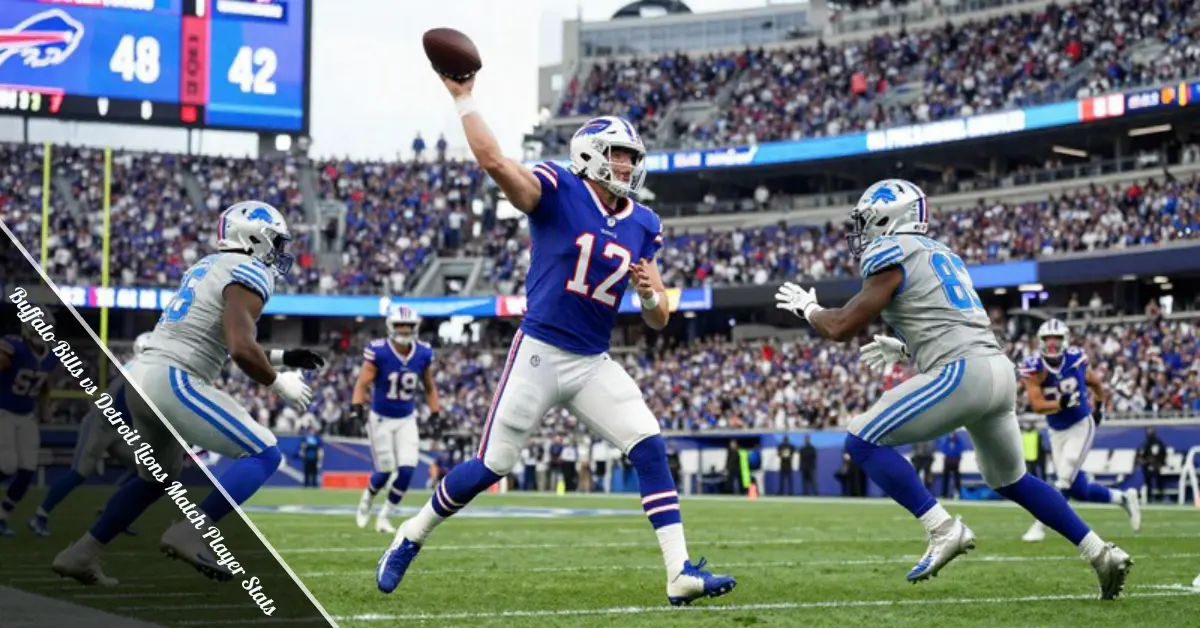
The Buffalo Bills defeated the Detroit Lions 48-42 on December 15, 2024, marking a significant moment in the regular season. Josh Allen threw for 362 yards and 4 total touchdowns while Jared Goff countered with 494 yards and 5 touchdown passes. James Cook rushed for 105 yards as Buffalo snapped Detroit’s 11-game winning streak in a thrilling football matchup.
Game Overview and Final Score
Buffalo’s 48-42 victory at Ford Field marked one of the highest-scoring games of the 2024 season. The Bills improved to 11-3 while ending Detroit’s franchise-record 11-game winning streak, dropping the Lions to 12-2.
The matchup featured 90 combined points and 1,080 total yards. Buffalo scored in all four quarters, putting up 14 points in both the first and third quarters before adding 13 in the fourth. Detroit rallied with 21 fourth-quarter points but fell short after a failed onside kick attempt, highlighting the pressure of late-game situations in NFL history.
The game took place before 65,327 fans at Ford Field. Buffalo controlled possession for 32:42 compared to Detroit’s 27:18, converting that time advantage into six more points despite Detroit’s explosive passing attack.
Quarterback Performance Comparison
Josh Allen delivered another dual-threat performance that has become his trademark. He completed 23 of 34 passes for 362 yards with two touchdown throws. Allen added 11 carries for 68 rushing yards and two rushing touchdowns, extending his NFL record with his sixth career game featuring multiple passing and rushing touchdowns.
Allen’s efficiency stood out with a 10.6 yards per pass average. He avoided interceptions and wasn’t sacked, giving him clean pockets throughout the afternoon. His touchdown passes went to Khalil Shakir and Ray Davis, while his rushing scores came in the first and fourth quarters.
Jared Goff matched his career high with five touchdown passes, completing 38 of 59 attempts for 494 yards. His passing yardage surpassed Allen’s by 132 yards, but Detroit’s inability to establish a ground game forced Goff into 59 pass attempts. He averaged 8.4 yards per attempt after accounting for three sacks that cost 21 yards, a solid performance for the QB.
Goff’s five touchdown passes went to five different receivers, showing his ability to spread the ball across the field. His 66-yard touchdown to Amon-Ra St. Brown on third-and-17 kept Detroit within striking distance late in the third quarter.
| Stat Category | Josh Allen | Jared Goff |
|---|---|---|
| Completions/Attempts | 23/34 | 38/59 |
| Passing Yards | 362 | 494 |
| Passing TDs | 2 | 5 |
| Interceptions | 0 | 0 |
| Yards Per Attempt | 10.6 | 8.4 |
| Rushing Attempts | 11 | 0 |
| Rushing Yards | 68 | 0 |
| Rushing TDs | 2 | 0 |
| Times Sacked | 0 | 3 |
Running Back Statistics
James Cook led Buffalo’s ground game with 14 carries for 105 yards and two touchdowns. Cook averaged 7.5 yards per carry, breaking tackles and finding lanes against Detroit’s depleted defense. His two scores gave the Bills a balanced offensive threat that kept the Lions from focusing solely on Allen’s arm.
Ty Johnson contributed primarily as a receiver but added value in the running game. His versatility showed in his five receptions for 114 yards, leading all Bills receivers. Johnson’s dual-threat ability created matchup problems for Detroit’s linebackers.
Allen’s 68 rushing yards came on designed runs and scrambles. His mobility extended plays and allowed receivers extra time to get open. His rushing touchdowns came from 1 and 4 yards out, showcasing his effectiveness near the goal line.
Buffalo totaled 197 rushing yards on 34 attempts (5.8 yards per carry), establishing offensive balance that controlled the clock and opened passing lanes.
Detroit Lions Ground Game
Jahmyr Gibbs managed just 31 yards on eight carries but scored twice through the air, contributing to the Detroit Lions NFL game. The Lions’ rushing attack struggled to gain traction, totaling only 48 yards on 15 attempts (3.2 yards per carry). Buffalo’s defense stacked the box and forced Goff to win through the air.
David Montgomery’s limited involvement reflected Detroit’s game script disadvantage. Playing from behind meant abandoning the run game early. The Lions’ inability to establish consistent rushing yards put additional pressure on Goff to carry the offense.
Detroit’s rushing yards per attempt dropped significantly below their season average. Buffalo’s defensive front controlled the line of scrimmage, limiting explosive runs and forcing the Lions into obvious passing situations.
Receiving Corps Breakdown
Amon-Ra St. Brown posted a career-high 193 receiving yards on 14 catches, setting a new personal record. His previous career best was 161 yards. St. Brown caught one touchdown and consistently found soft spots in Buffalo’s zone coverage. His 66-yard touchdown reception on third-and-17 demonstrated his ability to make game-changing plays.
Ty Johnson led Buffalo receivers with 114 yards on five catches. His 22.8 yards per reception average created vertical stress on Detroit’s secondary, showcasing the game information that led the Bills to a 48-42 victory. Johnson caught passes of 33, 24, and 31 yards, providing the explosive plays that complemented Cook’s ground game.
Khalil Shakir and Ray Davis each caught touchdown passes from Allen. Shakir’s score came in the second half as Buffalo rebuilt its lead. Dalton Kincaid returned from a knee injury to contribute four catches, adding depth to the Bills’ passing attack.
Sam LaPorta, Jameson Williams, and Tim Patrick combined for Detroit’s other touchdown receptions in a competitive football match. Dan Skipper caught a trick-play touchdown as an eligible offensive lineman, showing Detroit’s creative play-calling in attempting to stay close.
Detroit distributed targets across multiple receivers with 59 pass attempts, reflecting their aggressive game plan in the Detroit Lions NFL. This spread approach prevented Buffalo from keying on any single weapon but also meant no receiver besides St. Brown topped 70 yards in this football contest.
Defensive Player Stats
Terrel Bernard led Buffalo with 10 tackles (four solo), anchoring the Bills’ linebacker corps. His tackling kept Detroit’s yards after catch to a minimum on short passes. Buffalo’s defense forced one fumble through Christian Benford, which Matt Milano recovered.
Brian Branch topped Detroit’s defense with 14 tackles (eight solo). He played near the line of scrimmage frequently, attempting to slow Buffalo’s rushing attack and prevent any potential punt situations. The Lions’ defense struggled to generate consistent pressure without their injured defensive starters.
Ed Oliver recorded Buffalo’s only sack, pressuring Goff into hurried throws. Buffalo’s pass rush totaled three sacks (Oliver, Christian Benford, Greg Rousseau), disrupting Detroit’s timing routes and forcing Goff to adjust his footwork.
Detroit failed to record a sack against Allen, allowing him clean pockets throughout the game. The Lions’ defensive line couldn’t generate interior pressure, giving Allen time to survey the field and make precise throws.
Buffalo’s defense created the game’s only turnover when Benford forced a fumble that Milano recovered. This turnover led to a Bills scoring drive that extended their lead. Detroit’s zero turnovers by the Bills offense kept the Lions in contention despite trailing most of the game.
Team Statistical Comparison
Buffalo accumulated 559 total yards compared to Detroit’s 521, highlighting the impressive team stats from the matchup. The Bills averaged 8.2 yards per play against Detroit’s 6.8, reflecting Buffalo’s efficiency advantage in this exciting football game. Buffalo ran 68 total plays while the Detroit Lions needed 77 to reach similar yardage.
First down conversions favored Detroit 30-28, but Buffalo’s higher yards per play meant they needed fewer plays to advance the ball. The Bills converted 5 of 10 third downs (50%) while Detroit managed 6 of 13 (46%). Buffalo went 1-for-1 on fourth down attempts compared to Detroit’s 3-for-3, showing both teams’ aggressive approaches.
Red zone efficiency separated the teams. Buffalo scored on 5 of 7 red zone trips while Detroit went 5-for-5. The difference came in Buffalo’s ability to reach the red zone more frequently and convert those opportunities into touchdowns rather than field goals.
Penalties stayed relatively even, with Buffalo committing six for 49 yards and Detroit five for 41 yards. Neither team suffered from drive-killing penalties at crucial moments.
The turnover battle proved decisive. Buffalo committed zero turnovers while forcing one fumble from Detroit. This plus-one turnover margin provided Buffalo with an extra possession that translated into points in the box score.
| Category | Buffalo | Detroit |
|---|---|---|
| Total Yards | 559 | 521 |
| Yards Per Play | 8.2 | 6.8 |
| First Downs | 28 | 30 |
| Third Down | 5/10 (50%) | 6/13 (46%) |
| Fourth Down | 1/1 (100%) | 3/3 (100%) |
| Red Zone | 5/7 (71%) | 5/5 (100%) |
| Turnovers | 0 | 1 |
| Penalties | 6-49 | 5-41 |
| Time of Possession | 32:42 | 27:18 |
Key Statistical Takeaways
Allen’s record-extending sixth career game with multiple passing and rushing touchdowns places him in elite company. No other NFL quarterback has achieved this feat more than five times in regular-season play, a rare accomplishment in NFL history. His 362 passing yards marked a season high for the Bills’ quarterback, establishing him as one of the game leaders this week.
Goff’s five touchdown passes matched his career best, previously achieved earlier in his career with the Los Angeles Rams. His 494 passing yards represented one of the highest single-game totals of the 2024 season. Despite the loss, Goff’s performance showed his ability to compete against elite defenses.
St. Brown’s 193 receiving yards and 14 receptions both set career highs. His ability to consistently win at the catch point and gain yards after contact made him Detroit’s most dangerous weapon. The 14 receptions tied for the most by any receiver in a single game during the 2024 season.
Buffalo’s 48 points marked the most allowed by Detroit all season. The Lions entered the game with the league’s top-ranked defense but couldn’t contain Buffalo’s multifaceted attack. The Bills became the first team since the 2013 Denver Broncos to score 30-plus points in eight consecutive games.
The 90 combined points ranked among the highest-scoring games of 2024. Both offenses executed at high levels, with the game featuring seven combined touchdown passes and four rushing touchdowns. The final score reflected two elite offenses operating at peak efficiency rather than defensive breakdowns.
Detroit’s loss ended their 11-game winning streak, the longest in franchise history. The streak began in Week 5 and carried the Lions to a 12-1 record before falling to Buffalo. The loss opened the door for Minnesota to potentially tie for the NFC North lead.
Buffalo’s victory improved its record to 11-3, keeping it in position for the AFC’s second seed and highlighting its status as a game leader. The win continued Buffalo’s dominance over Detroit, extending their head-to-head winning streak to five games. Sean McDermott became just the fifth NFL coach to win 11-plus games in five consecutive seasons.
Cook’s 105 rushing yards gave Buffalo another 100-yard rusher, balancing their attack and preventing Detroit from keying on any single WR, a strategy often discussed in NFL news. His two touchdowns (TD) on the ground provided scoring variety that kept Detroit’s defense from adjusting effectively.
The matchup confirmed both teams as legitimate playoff contenders. Buffalo showed they can win shootouts against elite competition, as evidenced in the Bills’ 48-42 Lions game. Detroit proved capable of moving the ball against any defense, but must improve its ability to get stops when trailing. The statistical outputs from both teams suggest a potential playoff rematch could produce similar offensive fireworks, as seen in recent NFL news.
