
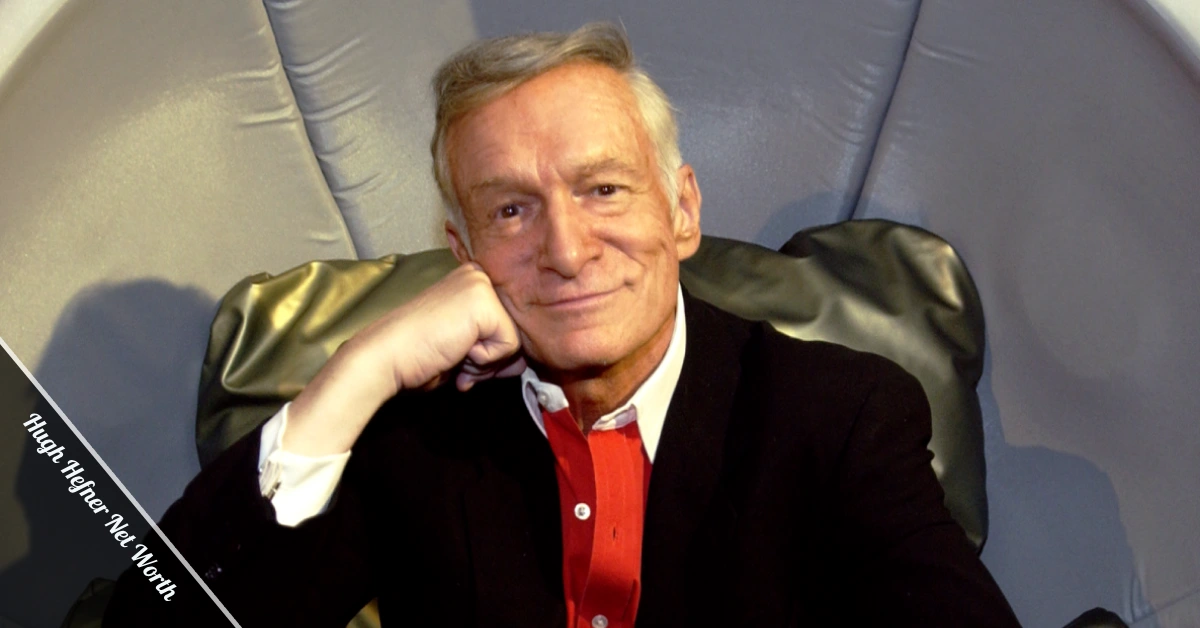
Hugh Hefner had a net worth of $50 million when he died in September 2017. The Playboy founder’s wealth peaked at $200 million in the mid-1990s but declined sharply due to falling magazine sales and his failure to adapt to digital media.
The man who lived surrounded by luxury and built an empire on the Playboy brand ended his life worth a fraction of his peak wealth. His financial story reveals how even a cultural icon can lose 75% of its fortune when its business model crumbles.
Hugh Hefner’s Final Net Worth
Hugh Hefner died worth $50 million on September 27, 2017, at age 91. This figure included his 35% stake in the Playboy brand and 100% ownership of Playboy magazine.
One year after his death, his estate sold that 35% brand stake for $35 million to private equity firm Rizvi Traverse. The magazine itself generated only about $100,000 annually by that point.
Surprisingly, Hefner never owned the famous Playboy Mansion. Playboy Enterprises owned the property, and Hefner paid roughly $1 million per year to live there. In June 2016, the mansion was sold to Daren Metropoulos for $100 million, with Hefner allowed to remain until his death.
His $50 million net worth at death was impressive by normal standards but represented a massive decline from his peak years.
How Hugh Hefner Built His Fortune
In 1953, Hugh Hefner scraped together $8,000 to launch Playboy magazine. He mortgaged his furniture for $600 and borrowed $1,000 from his mother, who wrote the check despite her husband’s objections.
The first issue featured nude photos of Marilyn Monroe from an earlier calendar shoot. Hefner produced the magazine at his kitchen table in Chicago. That December 1953 debut sold over 50,000 copies at 50 cents each.
The magazine exploded through the 1960s. Hefner turned Playboy into more than just a magazine. He opened Playboy Clubs across the country, launched television shows, and built a licensing empire around the iconic bunny logo.
By 1971, Playboy magazine reached its circulation peak of 7 million copies per month. That same year, Playboy Enterprises went public on the stock market, making Hefner a paper millionaire many times over.
The company expanded into casinos, clubs, and merchandise. Hefner became a celebrity himself, promoting a lifestyle of luxury that drew both admirers and critics.
Peak Wealth Period
Hugh Hefner Net Worth hit $200 million in the mid-1990s. At that point, Playboy Enterprises was generating tens of millions in annual profit from multiple revenue streams.
The company earned money from magazine sales, newsstand distribution, subscription revenue, and advertising. Playboy Clubs operated worldwide, charging membership fees and generating significant profits. Licensing deals put the Playboy logo on everything from clothing to jewelry.
Hefner also earned income from television shows, film production ventures, and personal appearances. The Playboy brand had become one of the most recognized in the world.
During this period, the magazine commanded premium advertising rates. Major corporations wanted access to Playboy’s affluent male readership. The business model seemed unshakeable.
But the internet was about to change everything.
The Decline of His Wealth
Between 2000 and 2010, Playboy’s stock price fell 80%. The magazine industry was collapsing, and Playboy got hit especially hard.
Free adult content flooded the internet. Men who once paid for Playboy subscriptions could now access similar material without spending a dime. Magazine circulation plummeted from its 7 million peak to under 1 million.
Hefner and his team were slow to adapt. While competitors built digital platforms, Playboy clung to its print model. The company eventually launched websites and digital content, but years too late.
Advertising revenue dried up. Companies that once fought for space in Playboy moved their budgets to digital platforms with better targeting and measurement. Print advertising rates collapsed across the industry.
In 2011, Hefner and private equity firm Icon Acquisition Holdings took the company private at $6.15 per share. This move protected Hefner from quarterly earnings scrutiny but couldn’t stop the bleeding.
His 2009 Financial Snapshot
A 2009 court filing during Hefner’s divorce from Kimberley Conrad revealed his finances. His monthly income totaled $290,580 from multiple sources:
- $116,667 salary from Playboy
- $121,099 in dividends and interest
- $17,058 from rental property
- $15,808 from HMH Productions
- $1,896 Social Security
- $17,639 other income
His assets totaled $43.2 million, including $36.8 million in stocks and bonds and $6.1 million in a joint account.
His biggest monthly expense was $53,593 for rent and mansion upkeep. He also spent $18,000 on food, $25,000 on entertainment, and $10,130 on college expenses for his children.
This snapshot showed his wealth had already stagnated at $43 million, well below his $200 million peak. Over the next eight years, it would rise modestly to $50 million, largely due to the 2016 mansion sale that freed him from that massive rental expense.
What He Owned at Death
Hefner’s $50 million net worth broke down into a few key assets. The most valuable was his 35% stake in Playboy Enterprises, which his estate sold for $35 million in August 2018.
He owned 100% of Playboy magazine, though the publication generated minimal revenue by that point. The magazine had transitioned from monthly to quarterly in 2019, two years after his death.
He held various personal property, investments, and real estate aside from the mansion. He maintained cash accounts and stock portfolios.
What he didn’t own mattered as much as what he did. The Playboy Mansion, valued at $100 million, belonged to Daren Metropoulos. Metropoulos purchased it in 2016 with the condition that Hefner could live there until his death.
The mansion sale actually helped Hefner’s finances. It eliminated his $1 million annual rent payment while guaranteeing him housing for life.
Who Inherited Hugh Hefner’s Fortune
Hefner’s four children received the bulk of his estate. Christie Hefner, his daughter who served as Playboy CEO from 1988 to 2009, got an equal share with her brothers David, Marston, and Cooper.
His third wife, Crystal Harris, received $5 million in cash plus a $5 million Hollywood Hills house held in a trust she controls. They had signed an iron-clad prenuptial agreement before their 2012 marriage that limited her inheritance.
The prenup specified that half of Hefner’s remaining estate would go to his children. The other half was earmarked for the University of Southern California Film School and various charities.
Hefner’s trust included an unusual provision about drug use. If trustees believed any beneficiary was dependent on illegal drugs or unable to manage their affairs due to substance abuse, all distributions to that person would be suspended immediately.
Reports suggested Hefner left $3 million to former girlfriend Holly Madison, though this was never confirmed. His first two wives, Mildred Williams and Kimberley Conrad, received divorce settlements years earlier and were not mentioned in his final estate plan.
Why His Net Worth Dropped
Magazine sales collapsed across the industry, but Playboy’s decline was steeper than most. The publication lost 85% of its circulation between 1971 and 2017.
Hefner failed to pivot to digital quickly enough. By the time Playboy built a serious online presence, competitors had captured the market. Free adult content sites dominated search results and social media.
Cultural shifts also hurt the brand. Playboy’s version of sexuality felt dated to younger generations. The magazine tried various approaches, including briefly removing nudity in 2016, but nothing reversed the trend.
His lavish lifestyle costs remained high even as his income fell. The $1 million annual mansion rent continued until 2016. Entertainment expenses, staff salaries, and maintaining his public image all drained resources.
The company’s value existed primarily in the brand and logo, not in the declining magazine. When Hefner’s estate sold his 35% stake for $35 million, it reflected Playboy’s worth as an intellectual property licensing business, not a publishing empire.
Hefner’s story shows how fortunes can evaporate when business models become obsolete. He built $200 million in wealth during print media’s golden age but couldn’t protect it when the digital age arrived.
