
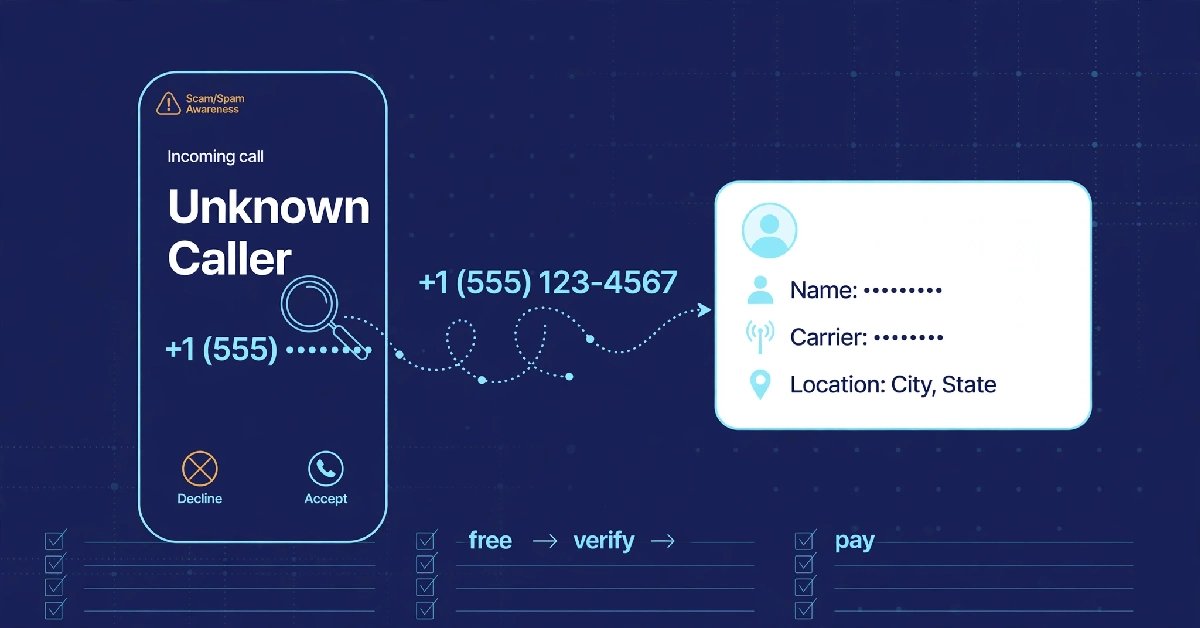
A number you don’t recognise called twice and left no message. Calling back blind is risky. Ignoring it leaves uncertainty.
A backwards phone number lookup — commonly called a reverse phone lookup — can help you identify the caller, flag a scam, or at least tell you what type of number it is. But it only works if you know what free tools can realistically do, when paying is worth it, and where the legal line sits. This guide walks you through that decision: free first, verify second, pay only if the gap matters, and act safely.
Key Takeaways
- “Backwards phone number lookup” is another name for reverse phone lookup. You start with a number and work toward a name, carrier, location, or spam signal.
- Free tools are strongest for landlines and business numbers. Cell numbers are harder because they are not published in public directories.
- Accuracy varies by number type. Cell phone lookups typically land in the 60–80% range on paid services. Free tools on cell numbers can drop to 10–20%.
- Never enter sensitive personal information into a free lookup site. Your own number, email, or address can be harvested.
- You cannot legally use consumer lookup data for hiring, tenant screening, credit, or insurance decisions. The FCRA restricts those uses.
- No result is a safety signal. If a number returns nothing across free tools and you call without leaving a message, do not call back. Block and report.
What “Backwards Phone Number Lookup” Actually Means
A backwards phone number lookup is the process of entering a phone number into a search tool to find information associated with it: an owner’s name, a carrier, a general location, or reports from other users about spam. It is the mirror image of a standard phone book search, which starts with a name and ends with a number.
People say “backwards” instead of “reverse” for the same reason they say “call back” instead of “return a call.” It is conversational, not technical. The underlying service is the same, and major lookup tools use the term reverse phone lookup.
What a backwards lookup is not is just as important. It cannot track a phone’s live GPS location from the number alone. It cannot pull “hacked carrier data.” And it cannot reliably identify every cell phone owner, because cell numbers are private by default and are not published in a central public directory.
How a Backwards Phone Number Lookup Works
Lookup tools do not have a magic database of every phone number. They aggregate data from several sources, and the quality of those sources determines what you see.
The main data sources are:
- Public records and directories: Historically strong for landlines and business numbers. Phone companies once published subscriber names and addresses; much of that legacy data persists in commercial databases.
- Data brokers and people-search aggregators: Companies that compile records from marketing databases, property records, court filings, and other commercial sources. Quality varies widely.
- Crowdsourced caller ID databases: Apps like Truecaller build name and spam labels from user contact books and user reports. This is why a number can show a name on one app and nothing on another.
- Web indexes: Google and other search engines surface phone numbers that appear on business websites, social media profiles, forum posts, and scam-report pages.
- Carrier metadata: Every number has a carrier and a line type (landline, mobile, VoIP). This is usually available even when no owner name is.
Why results vary between sites comes down to coverage and freshness. A site with a large but old database may show an outdated name. A site with a smaller but frequently refreshed database may show nothing for a number that was just reassigned.
Why Landlines Are Easier Than Cell Phones
Landlines were designed to be listed. For decades, phone companies published subscriber names and addresses, and that directory tradition left a deep paper and digital trail. Business landlines are even more visible because businesses want to be found.
Cell numbers were never part of that system. They are private by default, are not published in public directories, and are frequently reassigned. A paid lookup service can sometimes connect a cell number to a name through commercial data aggregation, but there is no single public “cell phone directory” for a free tool to query. This is the structural reason free cell phone lookups are weak. It is not a temporary technical limitation; it is how the data ecosystem is built.
Free Ways to Run a Backwards Phone Number Lookup
You can do a meaningful first pass without paying. The goal of the free stage is not to find a definitive owner name for a mobile number. It is to gather enough signal to decide whether a paid lookup or a safety action — like blocking — is warranted.
1. Google the Number in Quotation Marks
The fastest first step is also the most overlooked: put the full 10-digit number in quotation marks in Google, with and without dashes. Quotation marks tell the search engine to match that exact string, which filters out pages that merely contain the digits in a different sequence.
Example searches: “555-123-4567” or “5551234567”
Then refine the search by adding a keyword: “555-123-4567” scam, “555-123-4567” reviews, or “555-123-4567” business. Read beyond the first page. Business listings, forum posts, and community scam reports often appear on page two or three. A number that appears only on spam-report pages is a risk signal; a number that appears on a verified business website is a different signal.
2. Check Free Directories and Caller ID Apps
Free tools do different things, and their usefulness depends on the number type.
- Google: Surfaces business listings, forum posts, and scam reports. The full web index is its strength.
- Whitepages (free tier): Landline location and carrier; basic business info. Weak for mobiles.
- Truecaller: Crowdsourced name labels and spam reports. Decent for reported numbers, not systematic.
- NumLookup: Free US carrier and line-type lookup. Limited owner data.
- 800notes / WhoCallsMe: Community spam reports only. Not an identity database.
Use these as a first screen, not a verdict. A “spam likely” label from Truecaller is a reason to be cautious, not proof that the caller is a scammer. A missing result from Whitepages does not mean the number is fake; it may simply be a mobile number outside Whitepages’ free coverage.
3. Search Social Media and Messaging Apps
Search the number on Facebook, LinkedIn, and Instagram. Some people include a phone number in a public bio or a business page. If a profile surfaces, treat it as a lead, not confirmation: the number may be old, shared, or associated with a business rather than a person.
4. Use a Free Spam-Check Tool
Bitdefender and Malwarebytes both offer free phone-number checks that return a scam-risk signal. These tools are not identity lookups. They answer a narrower and often more useful question: “Is this number associated with known spam or fraud campaigns?” A high-risk flag is a strong reason not to call back. A clean result is not a guarantee of legitimacy.
When Paying Makes Sense — and When It Doesn’t
Pay when: the number is calling repeatedly, and free tools give you conflicting signals; you need a documented address or name for a high-stakes decision (e.g., verifying a contractor before a home visit); or the number is a business landline, and you need to confirm identity beyond a free directory.
Don’t pay when: it is a one-off unknown call with no voicemail; the free result already identifies a legitimate business; or the number is likely spoofed. A paid lookup on a spoofed number returns the spoofed number’s records, not the actual caller’s identity.
How Accurate Is a Backwards Phone Number Lookup?
Accuracy depends heavily on number type and service tier. These figures are estimates drawn from published vendor data and independent tests; they vary by data freshness and by the specific number you look up.
- Residential landline: ~60–70% on free tools; ~85–95% on paid services. Legacy directory data is deep and stable.
- Business landline: ~60–70% free; ~78% paid. Businesses want to be found, so listings are public and maintained.
- Cell phone (mobile): ~10–20% on free-only tests, up to ~40% on broader free surveys; ~60–80% on paid services. No public directory; commercial aggregation is partial.
- Business mobile: Low on free tools; ~45% paid. Unlisted, high turnover, privacy restrictions.
- VoIP: Very low free; ~32% paid. Internet numbers are cheap, disposable, and frequently reassigned.
The pattern: landlines are easier than cell phones, and business numbers are easier than personal mobiles. VoIP is the hardest category because the number may not be tied to a physical address or a stable subscriber record at all. No lookup is 100% accurate. Spoofing, opted-out records, number reassignment, and prepaid anonymity create permanent gaps that no service can close. A backwards phone number lookup is a screening tool, not a verdict.
Is a Backwards Phone Number Lookup Legal?
In the United States, the act of looking up a phone number is generally legal. The legal line is not the lookup itself. It is what you do with the information.
Generally permissible personal uses: identifying an unknown caller before deciding whether to answer or call back; verifying that a contractor, seller, or service provider is legitimate; screening calls for personal or family safety; checking whether a number is associated with known spam.
Prohibited or high-risk uses: harassment, stalking, or doxxing; pretexting (impersonating someone or lying to obtain information); unsolicited marketing that can violate the Telephone Consumer Protection Act, especially if the number is on the Do Not Call Registry; and FCRA-regulated decisions. The Fair Credit Reporting Act restricts the use of “consumer reports” to permissible purposes. Employment decisions, tenant screening, credit, and insurance underwriting are regulated categories that require a compliant consumer reporting agency, written consent, and adverse-action procedures. A consumer reverse-lookup service is not an FCRA-compliant background check, and using one for those decisions exposes you to legal liability.
Lookup Scams and Safety Risks Most Guides Don’t Mention
The rise of reverse lookup has created a secondary risk: lookup services themselves can be scams. The FTC reported that imposter scams alone cost Americans $3.5 billion in 2025, and total reported fraud losses reached $15.9 billion — an increase of roughly 27% from 2024. Lookup fraud is a smaller but real vector within that ecosystem.
Red flags of a lookup scam:
- “Free live GPS tracking.” No lookup service can track a phone’s live location from the number alone. If a site promises this, it is lying.
- Payment demanded before any result is shown. Legitimate services may ask for payment to unlock a full report, but they do not demand a credit card before confirming that any record exists.
- Requests for unrelated personal information. A reverse lookup needs a phone number. It does not need your Social Security number, your home address, or your email password.
- No privacy policy or terms of service. If a site will not tell you what it does with the numbers you enter, assume it is harvesting them.
- Subscription traps. A “one-time” payment that enrols you in a recurring charge is a common complaint pattern.
A specific privacy point: entering your own number into a lookup site can confirm that the number is active and add it to marketing or smishing lists. If you are testing a site, use a number you are comfortable exposing, or avoid the test altogether.
What to Do If the Lookup Returns Nothing
A no-result lookup is not a dead end. It is information. It means the number has no meaningful public or commercial record in the databases you queried. That can happen for several reasons: it is a new number that has not yet been indexed; it is a VoIP or prepaid number with minimal subscriber data; it is a cell number outside the coverage of free tools; it is a spoofed number that does not belong to the caller; or it is a number that has been deliberately opted out of commercial databases.
The safe next step depends on context. If the number called once and left no voicemail, do not call back. A missed call from an unknown number with no message is a common robocall or scam pattern, and calling back can confirm your number is active. Block it and report it to your carrier’s spam-reporting tool.
If the number is calling repeatedly and you have a legitimate reason to identify it — for example, it is tied to a business interaction or a family safety concern — a paid lookup may be justified. But even then, treat the result as a lead. Cross-check the name against the context that made you look it up in the first place.
Conclusion
The decision framework is simple: free first, verify second, pay only if the gap matters.
Start with Google in quotation marks and one free directory or caller ID app. If the number is flagged as spam, or if it returns nothing across free tools and you call without leaving a message, the safest move is to block and report — not to call back. If the number is tied to a real-world decision and the free result is incomplete, a paid lookup can fill the gap, but treat it as a lead rather than proof.
A backwards phone number lookup is a screening tool, not a verdict. Its job is to help you decide what to do next. The moment it stops doing that — and starts costing money for information you will not act on — is the moment to stop.
FAQs
What is a backwards phone number lookup?
It is another name for a reverse phone lookup. You enter a phone number to find the owner’s name, carrier, location, or spam reports associated with that number.
Can I do a backwards phone number lookup for free?
Yes. Google, free directories like Whitepages, caller ID apps like Truecaller, and spam-check tools like Bitdefender are free. Free tools work best for landlines and business numbers. Cell numbers often require a paid service for deeper data.
Is a backwards phone number lookup legal?
In the US, the lookup itself is generally legal. What matters is what you do with the information. Harassment, doxxing, pretexting, unsolicited marketing, and FCRA-regulated decisions are prohibited or heavily restricted.
How accurate is reverse phone lookup?
Cell phone lookups typically range from 60–80% accuracy on paid services, and can drop to 10–20% on free tools. Landlines are higher, often 85–95% on paid databases. Business landlines are around 78%; business mobiles around 45%; VoIP around 32%.
Can I find out who owns a cell phone number for free?
It is difficult. Cell numbers are not in public directories. Free tools may show a carrier or a spam report, but a verified owner name for a mobile number is rarely available without a paid service.
What if the number is spoofed?
A spoofed number displays a caller ID that does not belong to the actual caller. A lookup on a spoofed number returns records for the displayed number, not the real caller. Do not call back; block and report the number.
Can I use reverse phone lookup for hiring or tenant screening?
No. Consumer lookup services are not FCRA-compliant for employment, tenant, credit, or insurance decisions. Use a Specialized consumer reporting agency that follows FCRA procedures, including written consent and adverse-action notices.
